

Several years ago I bought a sewing machine. I thought I could learn to sew because I wanted to make curtains and pillow covers for my sofa and things like that. It’s still in the box. Now I think I should give it away because assuredly there are people out there who could use a new machine and who would put it to use. I don’t even know why I bought it since I’ve been resistant to sewing my entire life. This is ridiculous because it’s such a good skill to have, and yet.
When I was growing up in the 1970s, I didn’t have a good sense that my family didn’t have money because everyone had fewer things. Any given home would probably have one car parked out front. Inside, there was one television, one radio or stereo. Kids shared rooms and the rooms were pretty sparse. All the toys fit in one toy box. Book shelves, if there were any, were small and held just a few books and games. Beds were covered in mismatched quilts or blankets. Walls were largely empty. Most play happened outside.
It was a time when you went to Buster Brown before school started, you chose a pair of sturdy leather shoes, then you wore those shoes every single day until they either fell apart or you outgrew them. At home you had a pair of sneakers for playing, maybe a pair of dress shoes for church and weddings, a pair of sandals for summer. (We mostly went barefoot in the summer so that we didn’t wear out our shoes.) When I went to my friends’ homes, they had about the same number of clothes in their closets that I had in mine. This was something like a few pairs of pants, a few shirts, a dress or two. You had a couple of pairs of shorts in a drawer and pajamas.

For me, for years, most of the clothes hanging in my closet were made by my grandmother. This was great sometimes: when I wanted a dress like Laura Ingalls, boom! red calico dress coming right up. (memorialized in my 3rd grade class picture) This was often not great: my clothes didn’t look like the other kids’ clothes. Even if a classmate was wearing the rattiest, dirtiest t-shirt to school, it was still a store-bought t-shirt. My clothes tended to be stiffer: not tailored, but with more structure and made of fabric that wasn’t as soft. I also tended to wear skirts and dresses because “pants are too hard.”


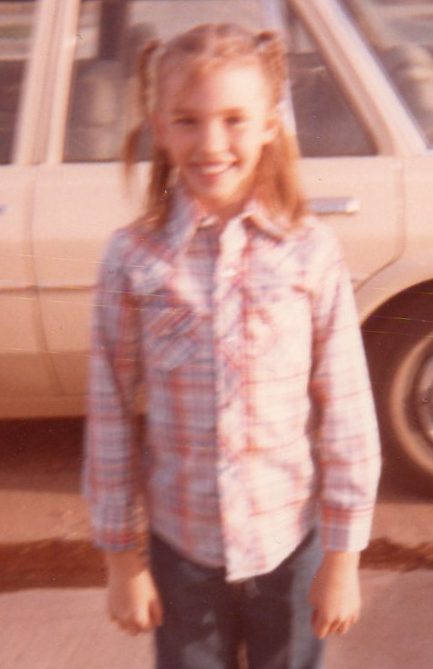
I began to resist wearing these clothes and as my grandmother and mother encouraged me to learn to sew, I refused. I didn’t want homemade clothes, even if I made them myself. By the time I was in 4th or 5th grade, my grandmother decided she didn’t want to sew that much anymore. She still made my dresses and the occasional shirt, but that’s it. Now my parents were left to find clothes for me (in addition to my three brothers) and my mother solved the problem: hand-me-downs.
Since I didn’t have older siblings or cousins, the hand-me-downs came from other girls in my town. Some were older, but some were in my class. I was a small human, shorter than a lot of the other kids, so I could wear their castoffs. Some of these clothes were really nice–nicer and more expensive and more fashionable than anything my parents would ever buy for me–but the humiliation of wearing something a classmate had recently been wearing was pretty terrible. They would point it out. They would tell me how much they liked or disliked certain items. They would tell other classmates I was wearing their old clothes. I wanted to shrink away.
My mother liked it better when my clothes were primarily dresses. She liked it best when we wore matching dresses. I balked at this, partly because dresses just weren’t to my liking, partly because they weren’t suitable for my outdoor playing, and partly because none of my friends wore dresses outside of church. My fashion choices were a constant source of conflict with my mother. It started when I was so young, I don’t even remember a time that we weren’t arguing over what I wore.
In first grade, I wanted to wear knee socks with sneakers in the summer. For some reason, this flew all over her and she forbade me to do it. Short socks only. When her friend’s teenage daughter came to visit and was wearing knee socks with sneakers, suddenly it became okay. The aforementioned hand-me-downs often included dressier items that my friends wouldn’t wear. Guess who did? I’ll never forget a particular outfit that was a jumpsuit with short pants. It was sleeveless. It was YELLOW. And it had red and blue trim around a big square yoke collar. I hated it as soon as I saw it folded up in the bag; unfurled, well it was a hundred times worse. My mother loved it and insisted that I wear it to school. The ensuing screaming match ended with my mother deciding to choose all of my clothes again. I was in 7th grade being treated like a toddler. We argued, cried, every single morning until my father put a stop to it and told me I’d wear what my mom put out. I was allowed to wear jeans once per week.
In high school, I spent two years in a Christian school (egads) that had a strict dress code. For girls, skirts below the knee, collared shirts, pantyhose, closed-toe shoes. (Ask me about toe cleavage sometime.) There was talk for a while about adopting uniforms and I begged for uniforms. I hated my clothes. My dad had been out of work off and on and the only reason my brothers and I were attending this private school is because my mom worked there. Her salary paid for our tuition. There was less money for clothing than ever, so my wardrobe was not only limited, it was shabby. We had moved to a new city, so even used clothing from my friends was no longer available. As I outgrew things, that was it.
In part 2, the things that resulted from nearly 18 years of clothing conflict and angst.